This post may contain affiliate links. Please see my disclosure policy for details.
How to Transform Your Home Into a Cozy Winter Haven Without Breaking the Bank
Cozy winter decor isn’t just about throwing a few snowflake pillows around and calling it a day.
I’ve spent years figuring out why some homes feel like a warm hug the moment you walk in, while others just feel… cold.
The difference isn’t budget or square footage.
It’s about understanding what actually makes a space feel inviting when the temperature drops and darkness arrives at 4:30 PM.

Why Most Winter Decorating Advice Misses the Mark
Here’s what nobody tells you: you don’t need to buy everything new each season.
You’re probably worried about spending a fortune on decor you’ll only use for a few months.
Or maybe you’re concerned your space will look cluttered with all those blankets and pillows everyone keeps recommending.
I get it.
I’ve made every winter decorating mistake possible, from overdoing the rustic farmhouse vibe until my living room looked like a barnyard, to buying cheap string lights that died after two weeks.
Let me save you the trouble.
Building Your Winter Color Foundation (Yes, This Actually Matters)
Neutral color palettes work because they mimic what winter actually looks like outside your window.
Think about it.
Snow isn’t just white—it’s cream, it’s gray, it’s sometimes even slightly blue depending on the light.
Start with these base colors:
- Winter whites (not stark white, but softer versions)
- Warm creams and tans
- Soft grays that don’t feel industrial
- Deep greens like evergreen trees
- Black for contrast (sparingly)
Here’s where most people mess up: they add too many colors.
Your winter palette should feel cohesive, not chaotic.
If you want to incorporate cool tones, stick to icy blues and muted grays that actually complement the winter landscape outside.
I learned this the hard way after purchasing decorative throw pillows in seven different colors one year.
My couch looked like a rainbow exploded on it.
Not cozy. Just confusing.
The Textile Layering Secret Nobody Talks About
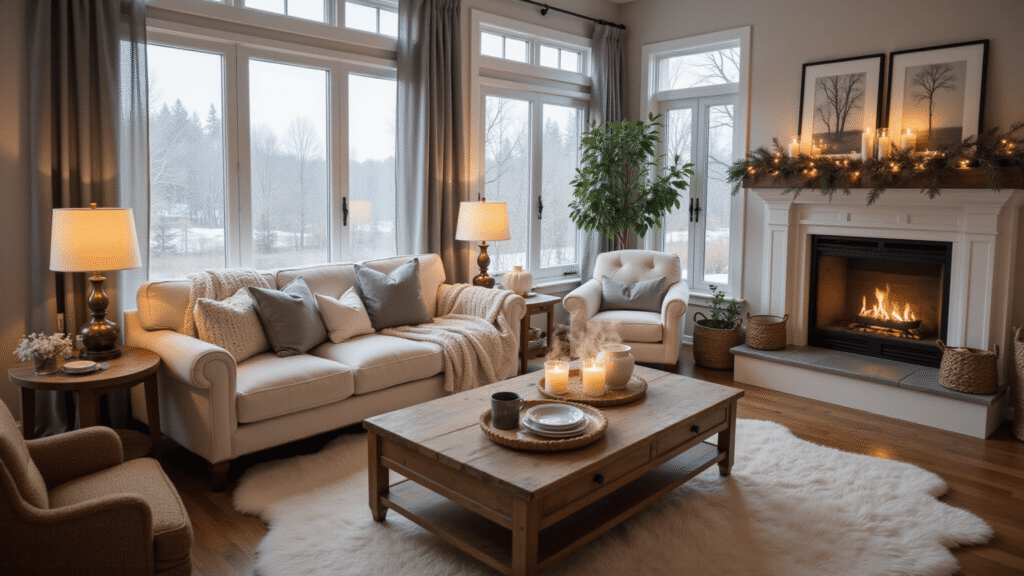
Layered textiles are non-negotiable for winter warmth.
But there’s a method to this.
You can’t just pile blankets randomly and expect magic.
Here’s my system:
For the sofa:
- One large chunky knit throw blanket draped casually over the back
- Two or three pillows in varying textures (knit, faux fur, velvet)
- A faux sheepskin rug draped over one arm
For chairs:
- One medium blanket folded and placed on the seat
- One accent pillow
For floors:
- Layered rugs if you have hardwood (a larger jute rug with a smaller sheepskin on top works beautifully)
The trick is mixing textures.
Smooth velvet next to nubby knit.
Silky faux fur beside chunky wool.
This creates visual interest that photographs beautifully and actually feels inviting to touch.
I keep a basket near my reading chair filled with extra blankets because guests always gravitate toward them.
It’s become a conversation starter.

Lighting: Where Most People Completely Fail
Soft, warm lighting changes everything.
I mean everything.
The same room that feels cold and uninviting with overhead lights suddenly becomes a sanctuary with the right lighting layers.
Forget what you think you know about “adequate lighting.”
Winter isn’t about adequacy—it’s about atmosphere.
Here’s my lighting formula:
Ambient layer:
- Table lamps with warm bulbs (2700K, not those harsh daylight bulbs)
- Floor lamps in corners that usually go dark
Accent layer:
- String lights (battery-operated ones for flexibility)
- LED candles with timers (life-changing, trust me)
- Real candles for when you’re actually home
Task layer:
- Reading lamps
- Under-cabinet lighting in kitchens
Install dimmers if you can.
If you can’t, just unplug your overhead lights entirely during winter evenings.
I’m serious.
The difference is staggering.
Last winter, I added battery-operated lanterns to my mantel and bookshelf.
My electricity bill didn’t budge, but the ambiance skyrocketed.
White lights on real or faux evergreen branches create that magical winter feeling without the full Christmas commitment.
Making Your Fireplace the Star (Even If You Don’t Have One)
Fireplace mantels are prime real estate.
If you have one, don’t waste it.
If you don’t, create a focal point elsewhere—a console table, a large shelf, or even a dresser top can work.
My mantel formula:
Height variation is key:
- Tall candlesticks or vases at the back
- Medium items (small lanterns, picture frames) in the middle
- Lower items (pinecones, greenery) in front
Texture mixing:
- Rough birch logs
- Smooth ceramic vases
- Soft greenery
The rule of three:
- Group items in odd numbers
- Three candlesticks, not four
- One large item, two medium, three small
On the hearth, I keep a large basket with rolled blankets.
It looks intentional and keeps throws accessible.
Another smaller basket holds kindling and adds to the cozy aesthetic even when the fire isn’t burning.